What's your value proposition?
A value proposition is a claim about fit: what your customer is trying to do, and how exactly you make that easier.
The sentence most companies cannot say
Ask ten employees why customers choose the company and you will often hear ten answers. Some will be features. Some will be history. Few will be about the customer.
A value proposition is the answer from the customer's side: what they were trying to get done, what was in their way, and what changed when they bought from you.
Start with the customer profile
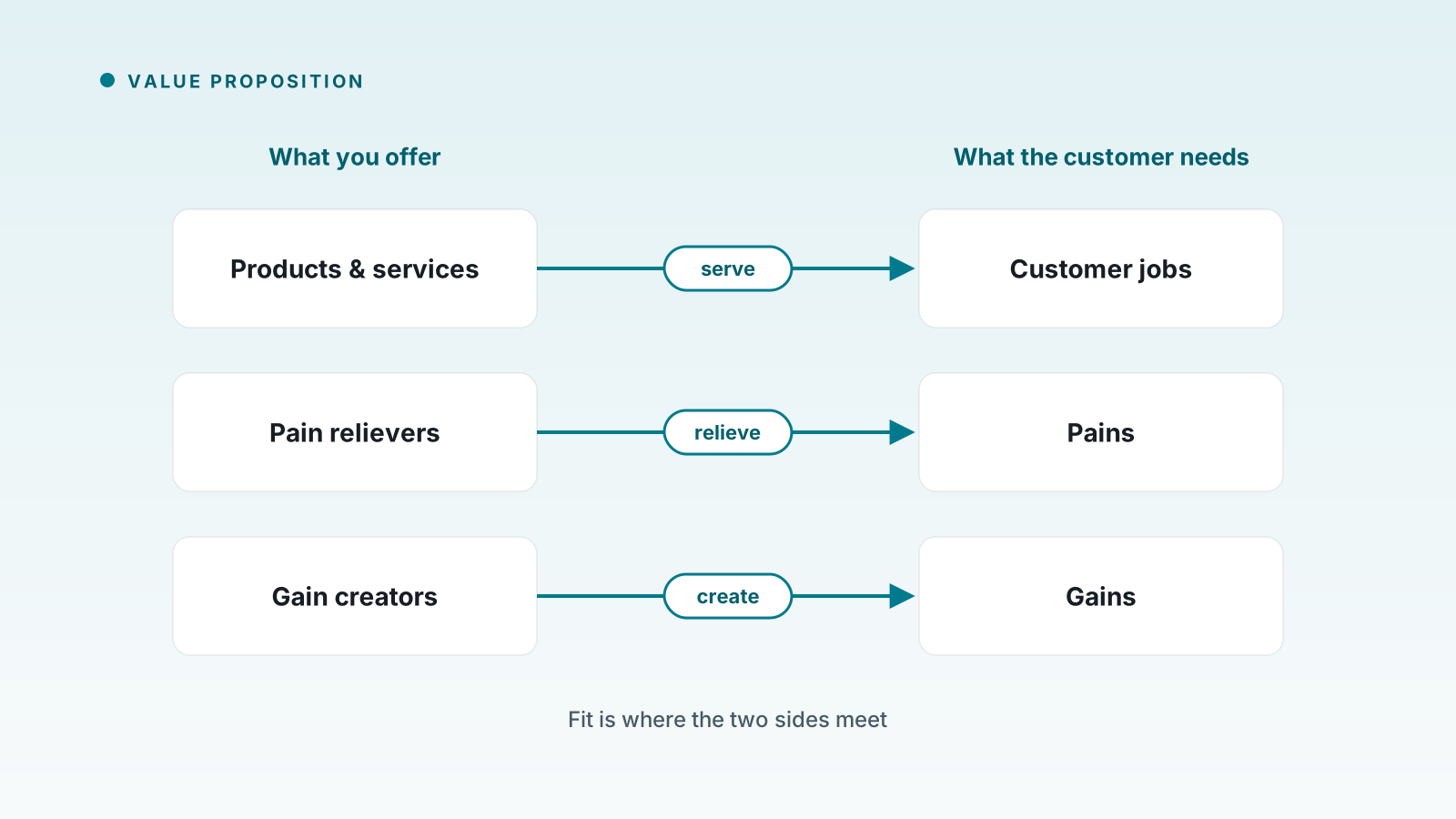
The Value Proposition Canvas has two halves. The first is the customer profile, and you fill it in before touching your own product.
List the jobs the customer is trying to get done. Then the pains: what makes those jobs slow, risky or expensive. Then the gains: the outcomes they would be delighted to get.
- Jobs: what they are trying to accomplish
- Pains: obstacles, risks and frustrations
- Gains: results they hope for
Then draw the value map
The second half is yours. List your products and services. Then, for each one, write which pain it relieves and which gain it creates.
Be strict about it. A feature that relieves no pain and creates no gain on the customer's list is a cost, however proud the team is of it.
- Products and services
- Pain relievers
- Gain creators
Rank before you match
Not every pain is equal. A customer may list ten frustrations, and two of them will decide the purchase. Before you draw lines to your products, rank the jobs, pains and gains by how much they matter to the customer.
The ranking has to come from them. Companies tend to rank highest the pains they happen to solve, which is how features nobody asked for get built. Ask customers which problem they would pay to remove first.
- Rank jobs by importance, pains by severity, gains by desire
- Use the customer's ranking, not yours
- Aim your proposition at the top of each list
Fit is the overlap
Put the two halves side by side and draw lines between them. Where a pain reliever meets an important pain, you have fit. Where a major pain has nothing pointing at it, you have a gap, and possibly your next product.
You do not need to address everything. Strong propositions usually cover a few pains and gains that matter a great deal, and say so in one sentence a customer would repeat to a colleague.
Write the sentence
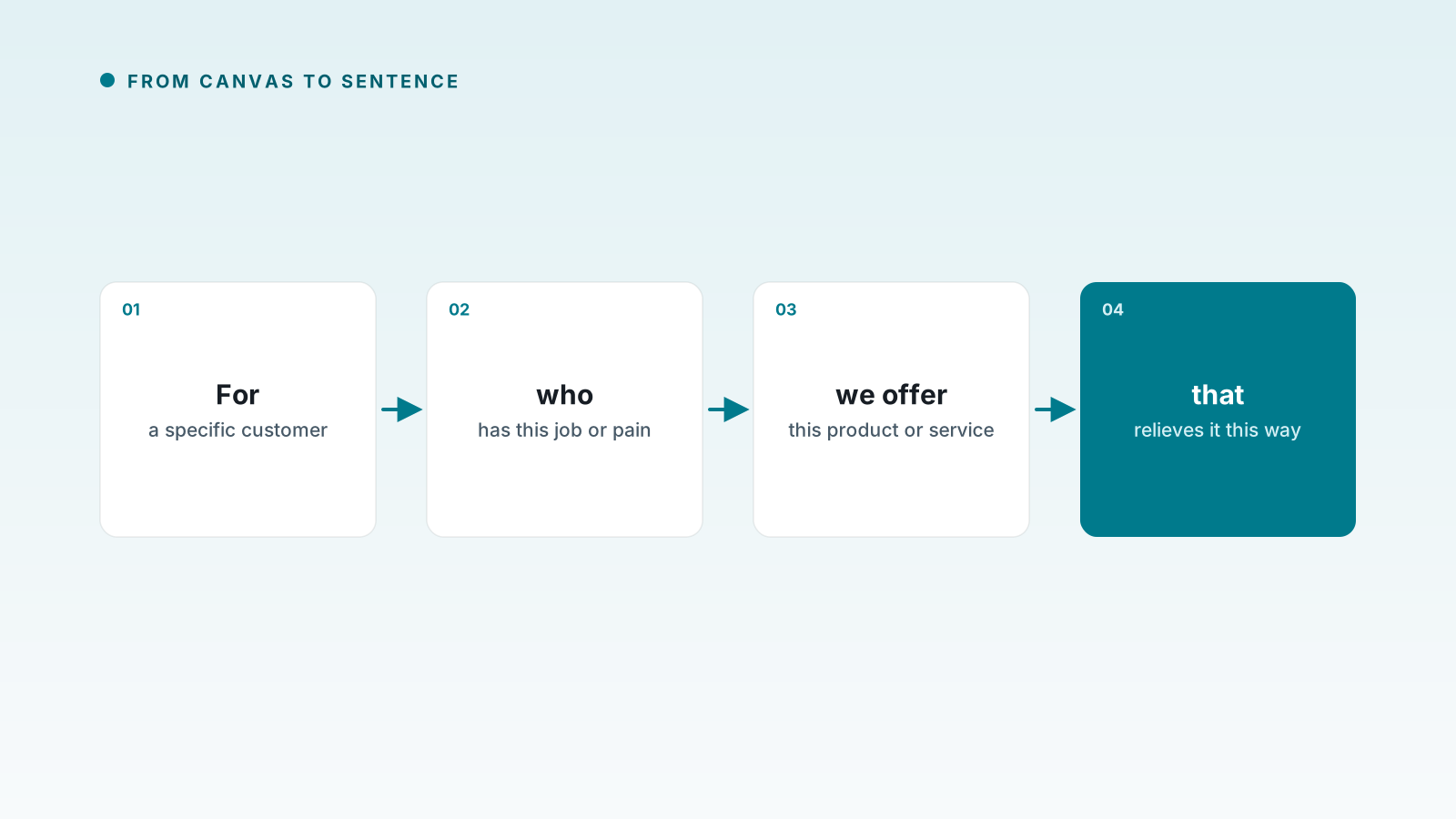
The canvas is working paper. What the market sees is a sentence. A reliable pattern is: for a specific customer, who has a specific job or pain, we offer a product or service that relieves it in a specific way.
Fill it in with plain words. If it only works with adjectives like “innovative” or “best-in-class,” the fit is not clear yet. A good version could be repeated by a customer to a colleague without notes.
Write one sentence per customer segment. If two segments need different sentences, they probably need different marketing, and sometimes different products.
Test it, then keep it current
Show the sentence to customers and watch their reaction. If they nod and move on, it is accurate and forgettable. If they say “yes, exactly, that's the thing,” you have found the wording. If they look puzzled, the fit is weaker than you thought.
Value propositions age. A pain that was severe three years ago may now be solved by everyone in the market, which makes it a requirement and no longer a reason to choose you. Review the canvas whenever a competitor changes its offer or your win rate moves.
- Test the wording on customers, not colleagues
- Check that the top pain is still a pain
- Revisit after any change in the competitive field