What a middle-market investor looks for
Size is only the first filter. The questions that follow are about cash, concentration, people and the situation the owner is in.
Size is the first filter, not the decision
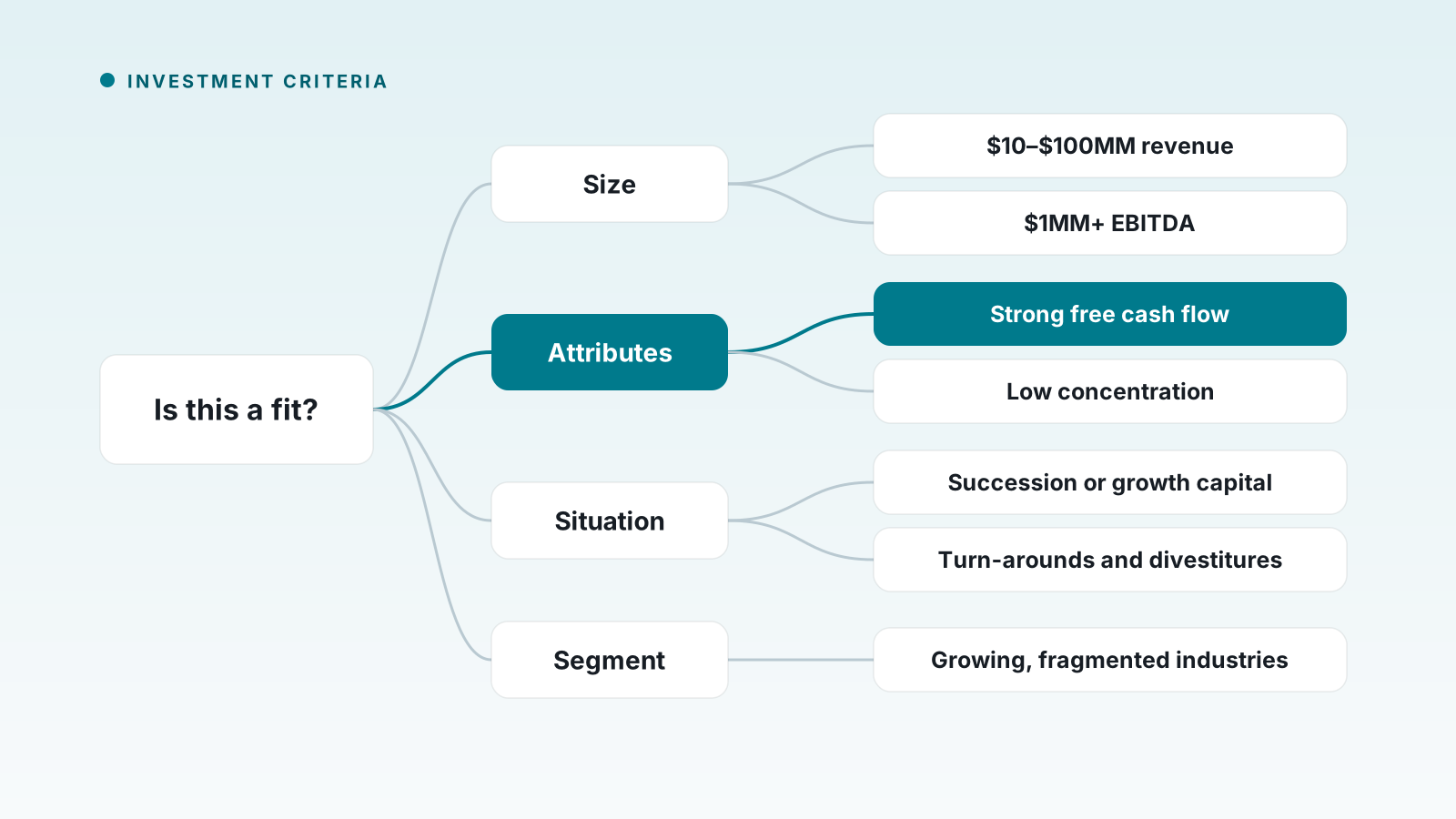
Every investor has a range it works in. Ours is companies with $10–$100MM in revenue and $1MM or more of EBITDA. A range like this exists for practical reasons: it sets how much capital a deal needs, how much help the management team is likely to want, and which buyers will be interested later.
Falling inside the range gets a conversation started. It says very little about whether the business is a good one. That comes from the next three questions.
- Know your trailing twelve months of revenue and EBITDA before the first call
- Be ready to explain any one-time items in those numbers
- If you are outside an investor's range, ask who they would refer you to
How the business turns revenue into cash
We prefer asset-light businesses with strong free cash flow. In plain terms: when sales grow, a healthy share of the new revenue should reach the bank account without first being spent on equipment, inventory or receivables.
Operating leverage is the related idea. If costs are mostly fixed, each extra dollar of revenue carries a higher margin than the last. Investors look for it because it means growth pays for itself.
- Strong operating leverage and free cash flow
- Minimal customer and supplier concentration
- Strong middle management that is excited about future growth
What the first conversations look like
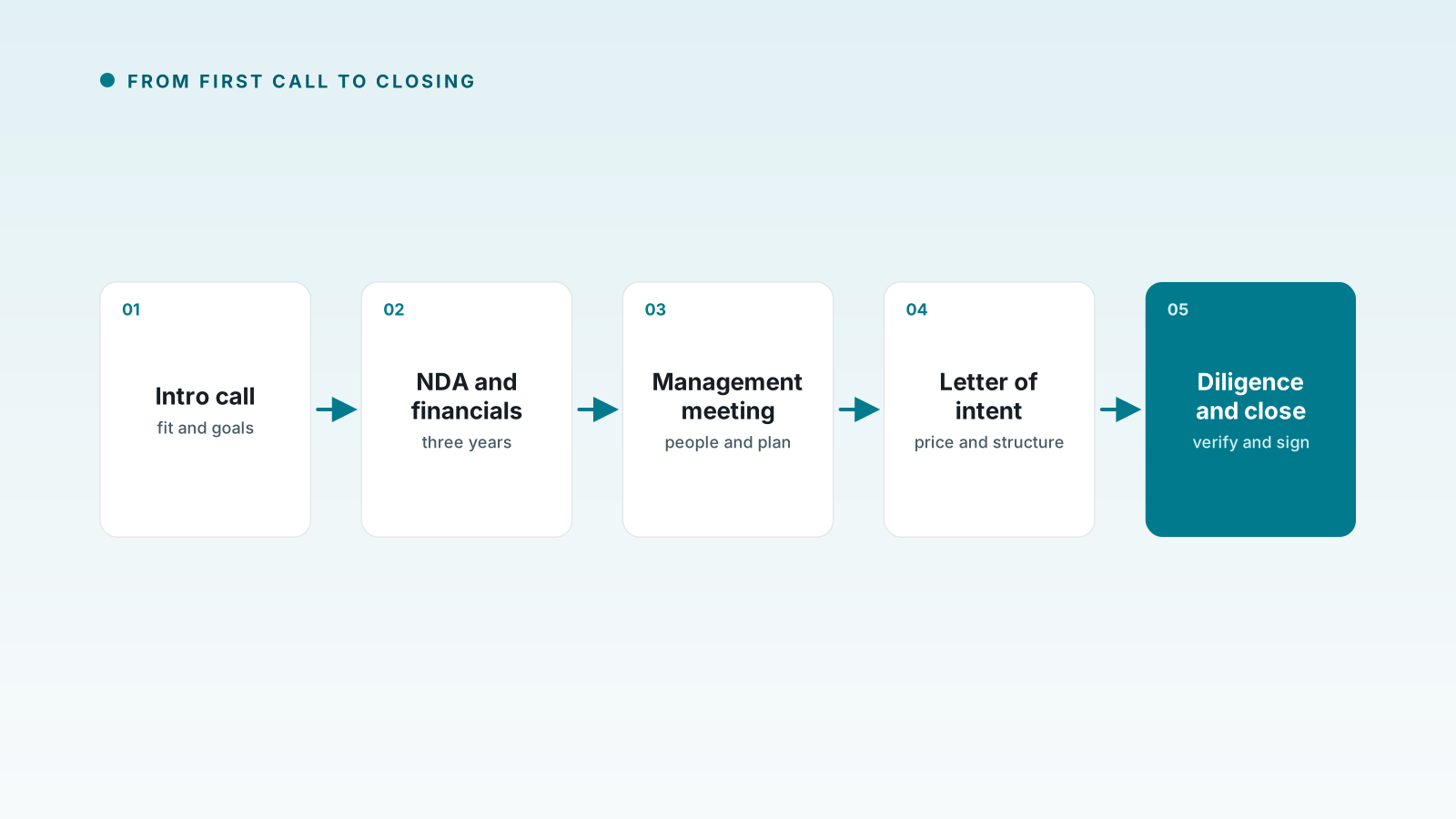
Most processes follow the same path. An introductory call covers what the business does and what the owner wants. If there is interest on both sides, a confidentiality agreement is signed and the owner shares financial statements, usually three years plus the current year to date.
A meeting with the management team comes next. Numbers describe the past, and the meeting is where an investor forms a view of the people and the plan. Only after that does a serious investor put terms on paper in a letter of intent.
None of these steps commits you to a deal. Each one is a chance for either side to stop, and stopping early is cheaper for everyone than stopping late.
- Ask for the investor's process and timeline on the first call
- Sign a confidentiality agreement before sharing financials
- Treat the management meeting as a two-way interview
Why concentration and middle management matter
A company that depends on one customer or one supplier has handed part of its future to someone else. That does not make it a bad company, but it changes the risk, and the price and structure of a deal will reflect it.
The same logic applies to people. If every decision runs through the owner, the business is hard to transfer. A capable layer of managers below the owner is often the clearest sign that a company can keep growing after a transaction.
- List your top ten customers and their share of revenue
- Do the same for suppliers you could not replace within a quarter
- Ask yourself who would run each function if you took three months off
The situation matters as much as the company
Good companies come to market for different reasons. Some are closely held or family-owned and facing succession. Some need growth capital. Some have a partner who wants out, or an entrepreneur who wants stronger leadership around them. Others are turn-arounds, workouts or divisions a corporation no longer wants.
Each situation calls for a different structure, so say plainly which one is yours. An investor who understands the real reason for the conversation can propose something that fits it.
- Succession planning, growth capital, partner buyout or leadership needs
- Turn-arounds, distressed situations and workouts
- Corporate divestitures
How to prepare your numbers
Investors read financial statements for trend and for quality. Trend is direction: are revenue and margins rising, flat or falling, and why. Quality is how repeatable the earnings are: recurring customers, contracts, and a mix that does not depend on one unusually good project.
You do not need audited statements to start a conversation, but you do need statements you can explain. Be ready to walk through revenue by customer and by product or service line, gross margin by line, and the main fixed costs.
If something in the history looks odd, say so before you are asked. A dip with a clear cause is far less worrying than a dip nobody mentions.
- Revenue and gross margin by customer and by line, three years
- A list of one-time items with a sentence on each
- Current-year results compared with the same months last year
What we tend to avoid, and why we say so
We tend to avoid businesses that are capital intensive, have unionized labor, or carry significant regulatory uncertainty. Other investors specialize in exactly those areas and do well in them.
Publishing what we avoid saves time on both sides. Before you approach any investor, read their criteria and ask what they pass on. A fast, honest no is worth more than a slow maybe.
Questions to ask the investor
The conversation should run in both directions. An investor is going to be involved in your company for years, in some cases as a member of the management team, the board or as an advisor. You are entitled to know how they work.
Ask where their capital comes from and how long they expect to hold an investment. Ask what they do after closing: who shows up, how often, and what decisions they expect to be part of. Then ask for owners they have worked with and call them.
- How involved are you after closing, and who from your side?
- How long do you usually stay invested?
- Which owners can I call for a reference?