A business plan on one page: the Lean Canvas
Nine boxes, fifteen minutes, one page. The Lean Canvas is the fastest way to find out whether you can explain your own business.
Why one page beats forty
A long business plan takes weeks to write and is out of date the day it is finished. Most of it is never read, including by the person who wrote it.
The Lean Canvas fits the whole plan on one page. You can fill in a first version in about fifteen minutes. The speed is the point: you can redo it every time you learn something, and you will learn something every week.
- Fast enough to rewrite after every customer conversation
- Short enough that a partner, lender or investor will actually read it
- Honest: an empty box is visible in a way a weak chapter is not
The nine boxes
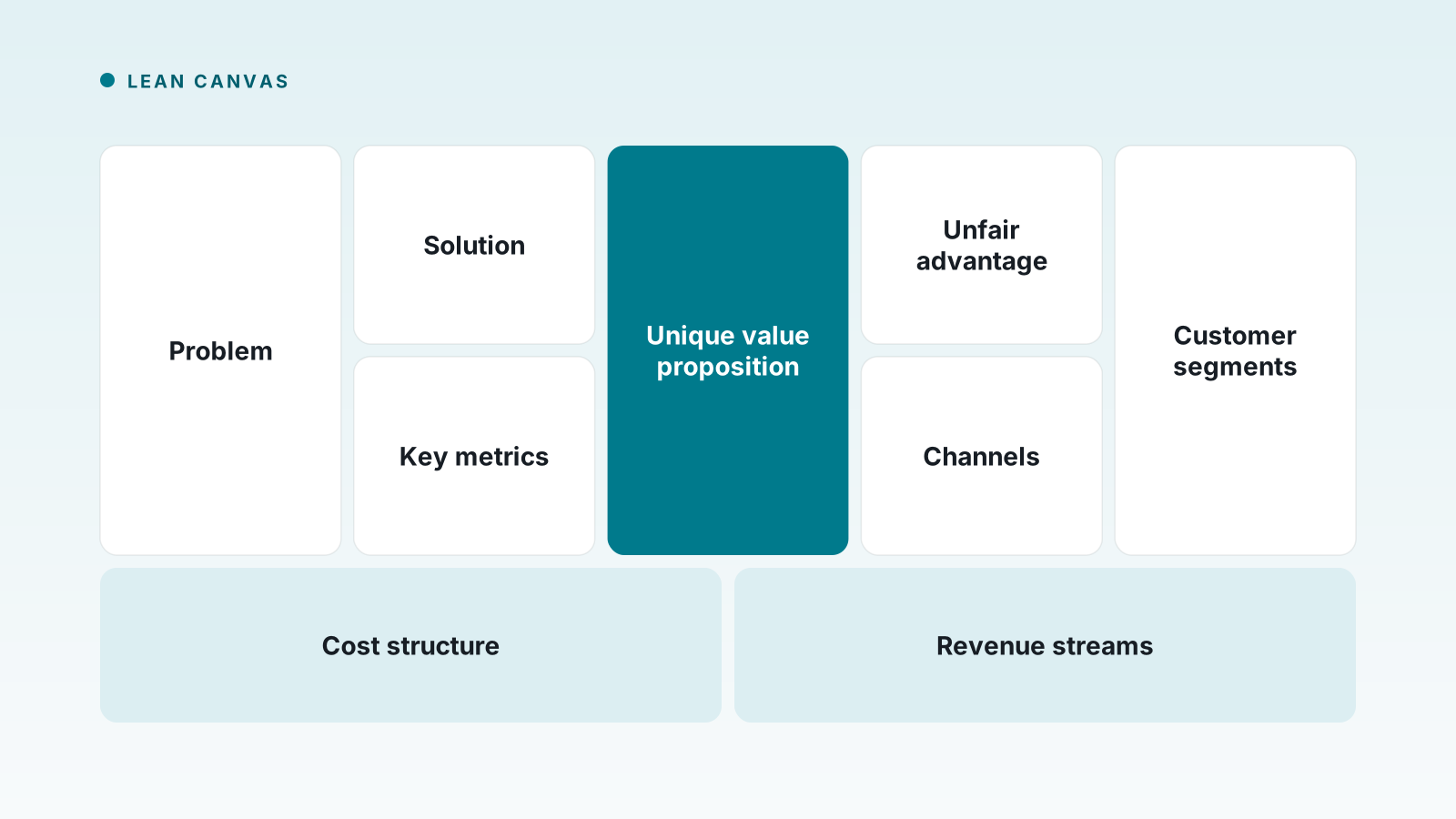
The canvas asks nine questions. Who are the customers, and what problem do they have? What is your solution, and why is it different? How do you reach customers, how do you make money, and what does it cost? What numbers tell you it is working? And what do you have that cannot easily be copied or bought?
The unique value proposition sits in the middle because everything else hangs off it. It is one clear sentence on why a customer should pay attention to you.
- Left side: problem, solution, key metrics
- Center: unique value proposition
- Right side: unfair advantage, channels, customer segments
- Bottom: cost structure and revenue streams
Fill it in this order
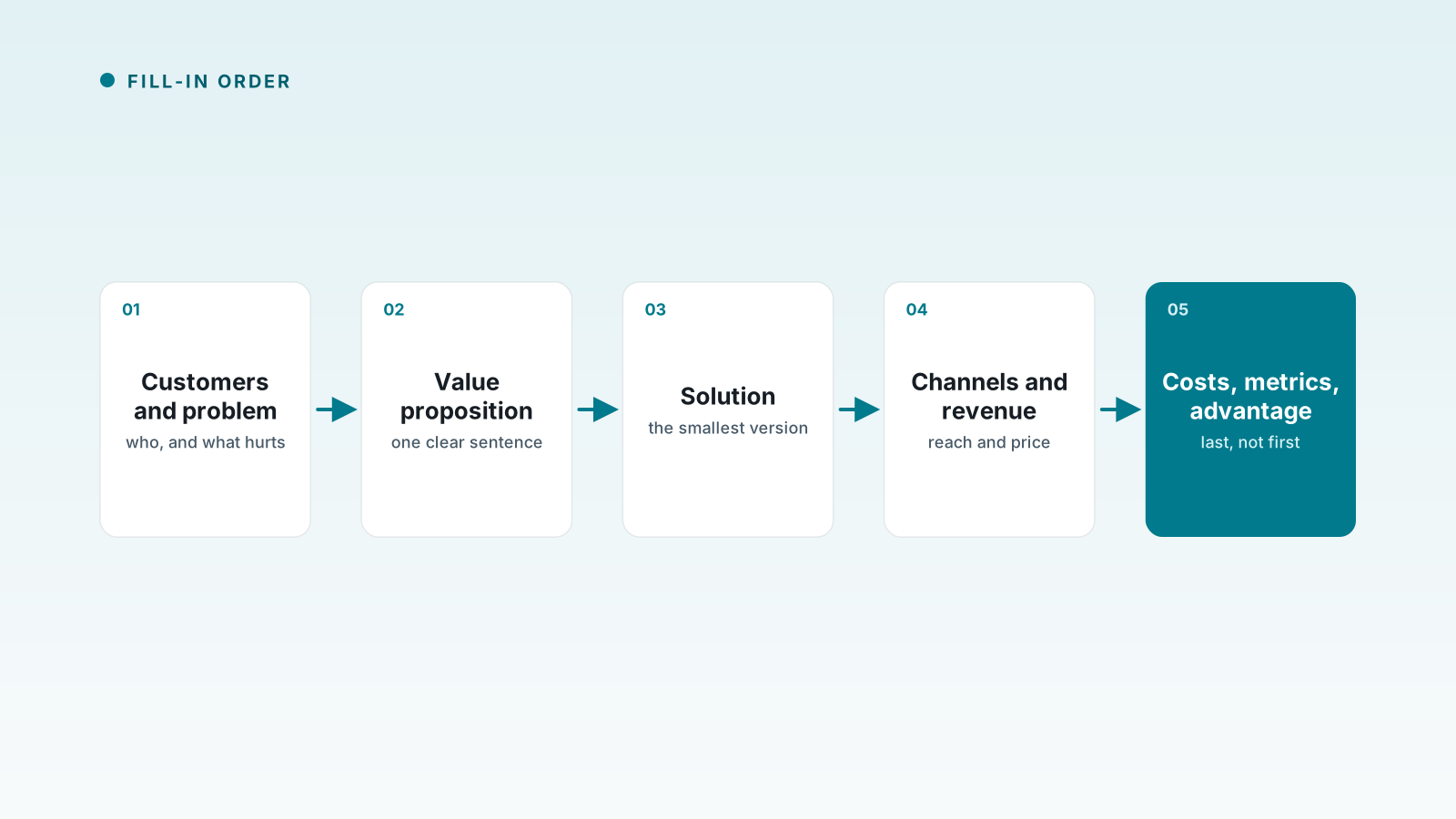
Start with customer segments and problem. They belong together: a problem only exists for a specific group of people. Then write the value proposition, and only then the solution.
Most people want to start with the solution because that is what they have been building. Resist it. A solution written before the problem tends to describe the product rather than the reason anyone needs it.
- Customers and problem first
- Value proposition before solution
- Leave unfair advantage for last; it is fine if it is empty at the start
How to test a single box
Every box holds a claim that could be wrong. To test one, turn it into a statement a customer could contradict. “Plant managers lose hours each week to manual scheduling” can be checked in a handful of conversations. “Our software improves efficiency” cannot.
Then go and ask. Ten conversations with people in your customer segment will tell you more than a month of desk research. Ask how they handle the problem today and what it costs them. Do not pitch. The moment you describe your product, people start being polite.
Write down what you heard next to the box, and change the box if the evidence says so. A canvas that never changes is a sign that nobody is testing it.
- Rewrite the claim so a customer could say “no, that's not true”
- Ask about what they do today, not what they would do
- Change the page when the evidence disagrees with it
Common mistakes
The most frequent mistake is a customer segment that is too wide. “Small businesses” is not a segment you can reach or interview. “Independent dental practices with two to five chairs” is. Narrow feels risky and is almost always right at the start.
The second is listing a solution in the problem box. “No good scheduling app exists” describes your product's absence. The problem is what the customer is losing because of it: time, money, or sleep.
The third is filling in the unfair advantage box with something that is easy to copy. Passion, hard work and a good team are valuable, and competitors have them too. If the honest answer today is “nothing yet,” write that.
What to do with the finished page
Treat every box as a guess. Pick the riskiest guess, usually the problem or the price, and go test it with real customers. Then update the page.
Keep the old versions. A stack of dated canvases is a record of what you believed and what you learned, and it is one of the more convincing things you can show a partner or an investor.
When one page is not enough
The canvas is a thinking tool. It will not replace a financial model, and a lender or investor will eventually ask for more detail than nine boxes can hold.
That is fine. Once the boxes have survived contact with customers, they become the outline for everything longer: the revenue box turns into a forecast, the channels box into a sales plan, the cost box into a budget. Writing those documents is much faster when the one-page version is already settled.
- Use the canvas to decide what the business is
- Use a model and a plan to show how it performs
- Go back to the canvas whenever the longer documents stop agreeing with each other