EBITDA and free cash flow in plain terms
EBITDA is the number buyers quote. Free cash flow is the number that pays the bills. Owners should know how one becomes the other.
What EBITDA is for
EBITDA stands for earnings before interest, taxes, depreciation and amortization. It strips out how a company is financed and how its assets are accounted for, so two businesses can be compared on operations alone.
That is why buyers and lenders quote it. It is a common yardstick. It does not measure cash, and owners who treat it as cash are often surprised.
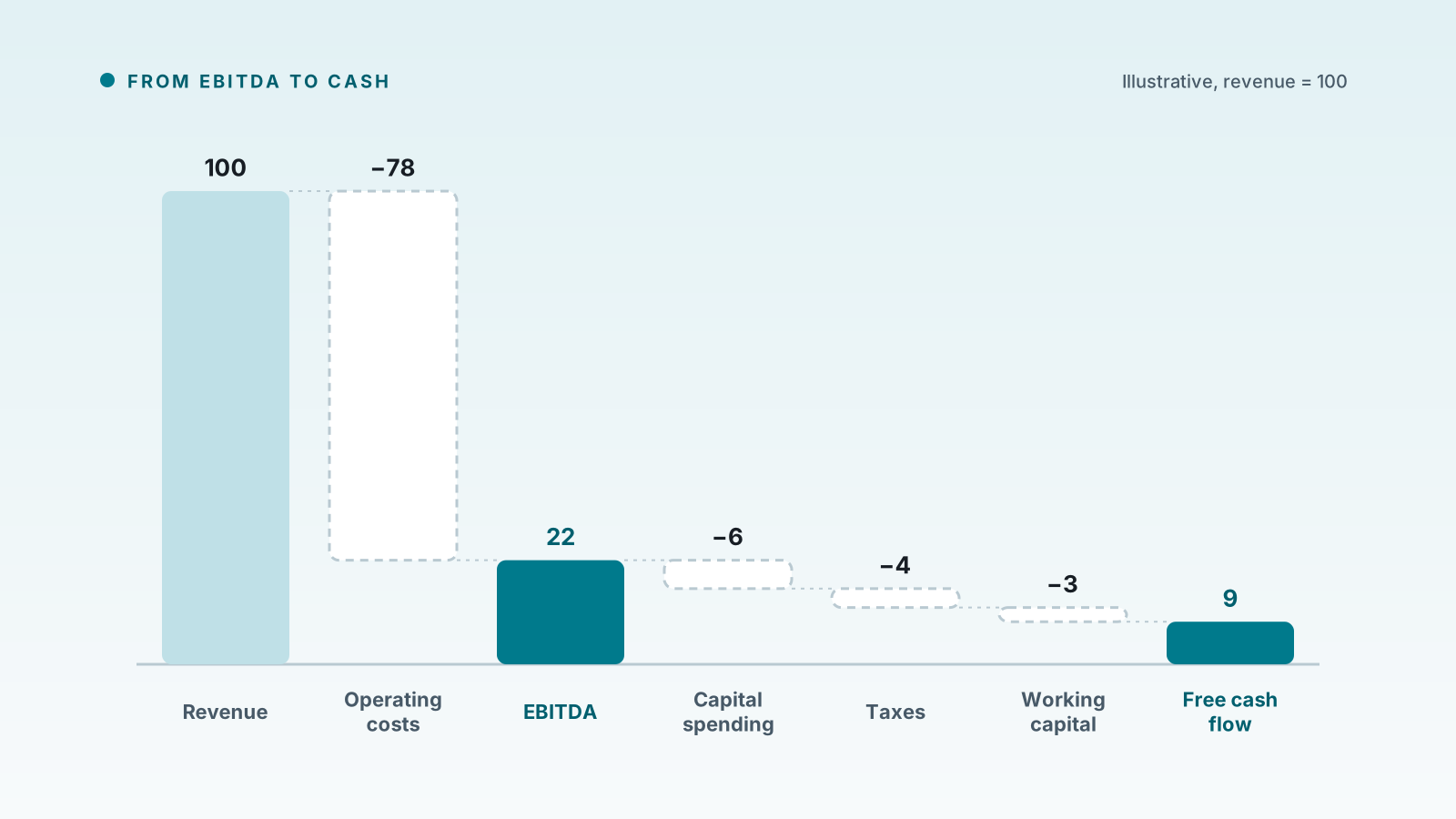
From EBITDA to cash
Three things sit between EBITDA and the money a business actually produces. Capital spending: equipment, vehicles, buildings and software that have to be bought to keep operating. Taxes. And working capital: cash tied up in inventory and in invoices customers have not yet paid.
What remains is free cash flow. It is the cash available to pay down debt, reinvest or distribute to owners.
- Start with EBITDA
- Subtract capital spending
- Subtract taxes
- Subtract the increase in working capital
Working capital, the quiet one
Of the three items between EBITDA and cash, working capital is the one owners most often overlook, because it never appears as an expense. It is simply cash that is busy.
When a company grows, it usually has to buy inventory and pay staff before customers pay their invoices. The faster it grows, the more cash is tied up. This is why a profitable, growing business can still run short of money.
The fix is in the terms. Collecting from customers a little sooner, holding a little less inventory, or agreeing slightly longer terms with suppliers can release a meaningful amount of cash without changing sales at all.
- How many days do customers take to pay?
- How many days of inventory do you hold?
- How many days do you take to pay suppliers?
Why asset-light businesses convert more
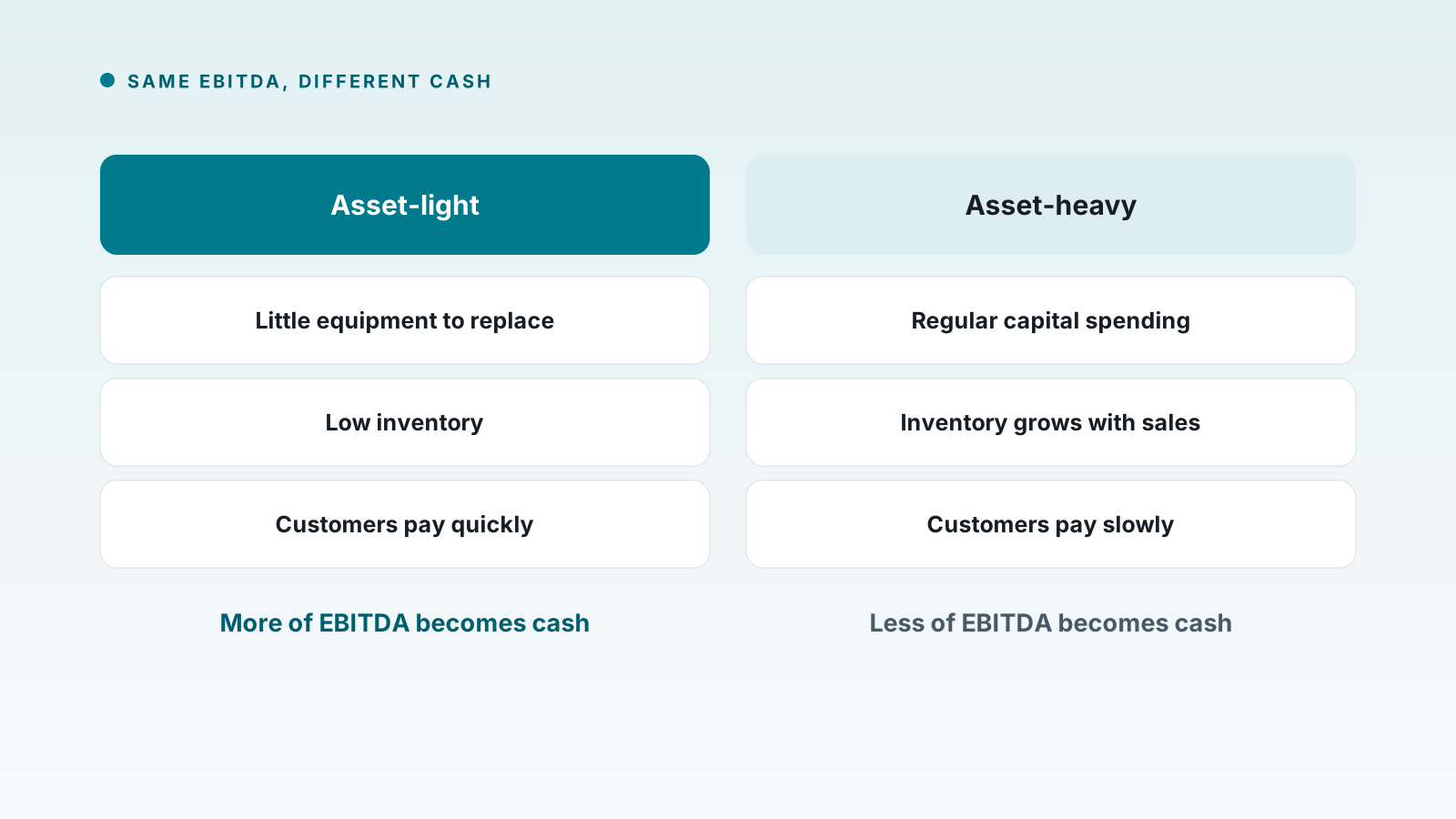
Two companies with the same EBITDA can produce very different amounts of cash. One that needs new machinery every year, or that must fund a large inventory to grow, keeps less of each dollar.
This is the reason we prefer asset-light businesses with strong free cash flow. Growth in such a business funds itself, and that gives owners and partners more choices.
Operating leverage
Operating leverage describes how profit responds to sales. When a large share of costs is fixed, an increase in revenue brings a larger increase in profit, because the fixed costs are already covered.
It cuts both ways. The same structure makes profit fall faster when revenue drops, so know which of your costs truly stay put.
- Sort your costs into fixed and variable
- Work out the margin on the next dollar of revenue, not the average one
- Test what happens to profit if sales fall by a tenth
Three numbers to watch every month
You do not need a finance department to keep an eye on this. Three numbers, tracked monthly, tell most of the story.
The first is EBITDA margin: EBITDA divided by revenue. It shows whether operations are getting more or less profitable. The second is cash conversion: free cash flow divided by EBITDA. It shows how much of the reported profit turned into money. The third is the change in working capital, which explains most of the gap between the first two.
- EBITDA margin: is the operation getting more profitable?
- Cash conversion: how much profit became cash?
- Change in working capital: where did the rest go?
How buyers use these numbers
In many transactions, price is discussed as a multiple of EBITDA. The multiple is not a fixed number. It moves with how much a buyer trusts the earnings to continue and to turn into cash.
That is why two companies with identical EBITDA can receive different offers. Steady margins, low customer concentration, modest capital needs and a team that can run the business all support a higher multiple. Each is something an owner can work on years before a sale.
A note on adjustments
In a sale process, EBITDA is usually adjusted for items that will not recur: a lawsuit, a one-time bonus, an owner's personal expenses run through the company. Adjustments are normal and buyers expect them.
They also check every one. Keep documentation for each adjustment, and leave out the ones you would struggle to explain. This article is general information, not accounting, tax or investment advice.